
The Makers of Modern China
Zheng Xiaoqiong
Translated from Chinese by Eleanor Goodman
10.12.2025translation
For many years, Zheng Xiaoqiong has collected the stories of the workers whose migration to Guangdong powered China’s manufacturing revolution
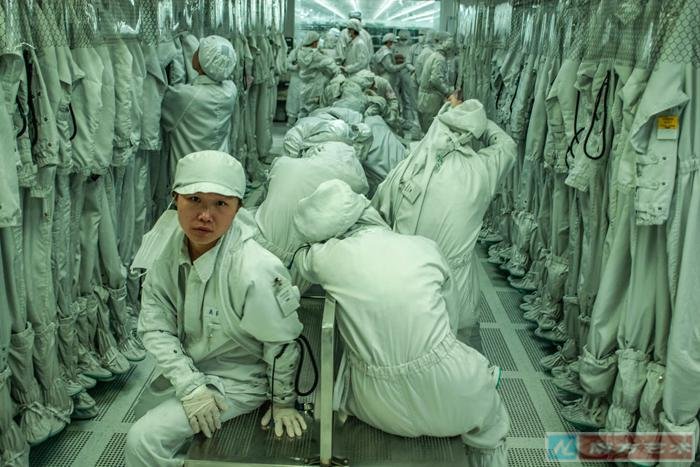
Zhan Youbing: Workers at the changing room of an electronics factory, Dongguan, China (2011)
Introduction by Kaiser Kuo
I first encountered Zheng Xiaoqiong’s writing in Iron Moon, a collection of Chinese worker poetry skilfully translated by Eleanor Goodman (2016). What struck me then about her poetry, and what remains true in this prose selection, is Zheng’s attentiveness to the texture of migrant-worker life. She restores dignity not through political theatrics, but through rigorous sensory detail: the clang of metal, the sting of dust, the smell of dirty socks, the fluorescent fatigue of factory nights, and cramped dormitories where shirtless men play cards and chainsmoke. She records the world as it is felt by the people who move through it. In doing so, she opens a space in which they can be seen as individuals – complicated, vulnerable and never reduced to symbols.
These subjects are caught in a trap that has structured millions of lives over the past four decades. On one side lies the village: impoverished, agrarian and socially stifling. On the other lies the city: dazzling and modern, but also cold, precarious and brutally indifferent. Zheng’s writing captures the psychic tension of that in-between space – the feeling of being suspended between two worlds, belonging fully to neither. She resists both the standard, agency-stripping sweatshop narrative and the counternarrative of migrant labour as liberation from rural drudgery.
Patterns emerge across provinces and generations: young people whose schooling stopped because families could not afford the fees; ethnic minority children from remote mountainous communities labouring in the industrial south; women leaving home to escape constricting expectations, only to encounter new forms of gendered exploitation; men watching years slip by under the grind of overtime. But these patterns never feel generic. Zheng approaches each person individually, letting their memories and private cosmologies make themselves known.
Zheng can do this because she has lived this life. For more than a decade, she was based in an “urban village” outside Guangzhou – one of many such dense enclaves where migrant workers negotiate despair. She worked factory jobs, sleeping in those same dormitories. Between 2006 and 2015, she interviewed people in alleyways, restaurants and rented rooms, assembling a kind of oral history of the great migration to Guangdong. The resulting manuscript, Woman Worker, edged close to citizen journalism – a perilous vocation in contemporary China. Much of the text was considered too sensitive domestically, and Zheng has refused to accept the extensive redactions that some would-be publishers have demanded. So the book has never been published.
These narratives offer a window into Zheng’s life and work. The experiences they chronicle are often harsh – stories of exploitation and violence in the shadows of China’s industrial rise. But Zheng never frames her subjects solely through suffering. She captures flashes of solidarity, humour and stubbornness. Her sensitivity is humanising, holding both the structural and the intimate in view: the vast demographic movement of internal migration, and the individual lives that give it moral weight. She is a participant and an observer, a sympathetic advocate – but not an activist.
Goodman has continued to translate her work for publication, including a collection of poems, In the Roar of the Machine, and the chapters of Woman Worker that appear here for the first time. Her translations preserve the steadiness of Zheng’s gaze. These are the stories of people who built modern China, but were rarely invited into its narrative. Zheng listens to them. And because she does, they enter the record not as anonymous labourers, but as full human beings.
1.
Zhao Fang’s Story
I met Zhao Fang 17 years after she’d left her village. Born in the late 1970s in the northern lake region of Hunan, she’d married a man from the mountains of southern Jiangxi. In nearly two decades, she had rarely gone back to either province, and instead floated around Guangdong between Dongguan and Shenzhen, living the factory life. When we met, she was working as a sewing machine operator in a wool textile factory in Dalang, Dongguan. As her son played on the floor of their rented apartment, she told me the story of why she had decided to leave home. “There was just nothing for me there,” she began. “I couldn’t stay.”
Zhao Fang never graduated from middle school. Her grades had been mediocre, which made it unlikely that she would have passed the high school entrance exam, and her family couldn’t afford to send her to vocational training. So she chose to quit altogether. All those years later, she still remembered the details clearly.
It had been the busy farming season. Most of Hunan cultivates two crops of rice annually. After the early summer crop has been harvested, the fields are immediately tilled, and seedlings planted for a late crop – this is known as a “double hustle”. Back then there was no farm machinery in the village. Zhao Fang was the family’s principal labourer, the most expert at both planting and harvesting. As she told me this, she pointed to her son: “This generation has it a lot better than mine did.”
Zhao Fang showed me the scars on her little finger. “This is from cutting rice stalks. Where I’m from, everyone my age has scars like this on their hand.” Later, when she took me to meet some of her fellow villagers living in the city, I paid attention to their left hands. Just as she’d said, they each had scars on their forefinger, middle finger or pinkie. Some scars were shallow, others deep – all childhood injuries.
In order to sit for the eighth-grade advancement exam, students had to attend an additional month of instruction in August. This cost 60 yuan and 15 kilograms of rice, for the teacher’s overtime and the school lunch. Zhao Fang’s parents didn’t have the money. They told her to attend the first few days of classes, and promised to pay the teacher later. But she was too embarrassed to do so, and stayed home to continue with the rice planting. That was the end of her studies. “I remember it to this day,” she told me. “Because of that measly 60 yuan in school fees, I couldn’t finish middle school.” She still seemed to hold it against her parents.
*
“There was nothing for me to do in the village other than help with the farm work,” Zhao Fang said. After quitting school, she stayed at home, often quarrelling with her mother. Jobs were scarce, and a nanny position that her mother tried to arrange for her fell through.
After a few years, she told me, “I really didn’t want to stay at home any longer. I had turned 17, and although it seems so young to me now, at the time I felt like an adult and I wanted to be in charge of my own life. If I’d stayed at home, a matchmaker would have come to the house when I turned 18. In a year or two I’d be married, and I’d be repeating the life my mother had.” She continued: “Sometimes I’d sit in the kitchen and watch my parents bustle around the wood-burning stove. Since our village was poor, we burned branches, rice straw, cotton stalks… things with a lot of debris. My mother would come back from the paddies with her trouser legs rolled up and her hands still covered in mud, and she’d go straight to the stove to light a fire to cook our food and to boil feed for the pigs. When she bent down to shove rice straw into the belly of the stove, dust would cover her hair. The choking smoke made her tear up. I told myself that I couldn’t repeat my mother’s life. I wanted a different kind of life – I had to leave the village!”
“I had to leave!” A whole generation of rural youngsters felt this yearning. They didn’t know where they could go or what they could do, or what the outside world would be like. But they knew their future lay in some faraway place, in distant cities and factories, not in their backwater villages. They knew that hardship and setbacks were likely if they migrated, but that didn’t affect their determination to leave home.
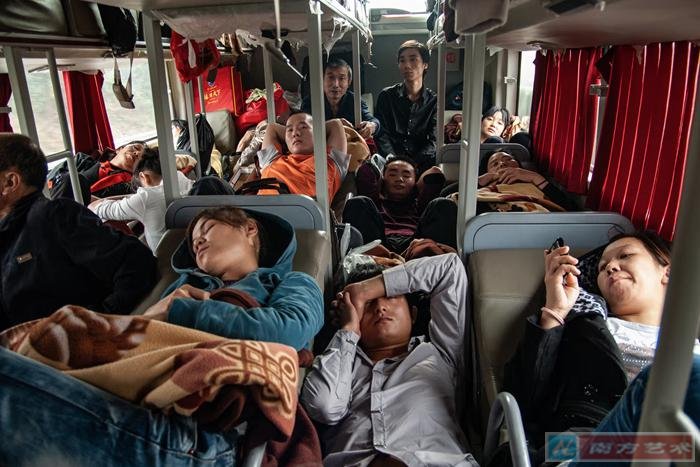
Zhan Youbing: Workers riding a long-distance bus, Dongguan, China (2011)
Most of Zhao Fang’s classmates chose not to take the high school test, and they couldn’t afford a vocational education either. She herself was not given the opportunity to train as a hairdresser or a seamstress, so instead she stayed at home and helped out on the farm. In the agricultural off season, she often biked over to her classmates’ homes to hang out. She wasn’t the only one with ideas about leaving. One of her classmates went to Changsha to be a nanny, while a few others with connections there became sales clerks or sanitation workers, to the envy of their classmates.
The village was remote, without telephones or internet, and news arrived by letter or word of mouth. This is how Zhao Fang learned that a classmate’s cousin was working in Shenzhen, Guangdong. He apparently earned 700 or 800 yuan a month – more than the village teacher, or many of the local government employees.
The village was full of stories about Guangdong back then. It was said that businessmen from Hong Kong and Taiwan came there to set up factories; there was gold just waiting to be grabbed. If someone dropped a five-mao coin in Shenzhen, no one even bothered to pick it up. Zhao Fang tried to calculate how much she could make in a day by collecting these coins. She laughed as she told me this, and my laughter mingled with hers. I was in school in Nanchong at the time, and my strongest impression of Guangdong was also of five-mao coins lying everywhere on the ground. I’d had the same idea as Zhao Fang – to go there to scoop up all that abandoned money.
*
The 1990s in rural China was an era of Hong Kong films, old-fashioned VCRs, fuzzy TV screens, and constraint; the odour of cheap cigarettes and foot stench and sweat stink and talcum powder… these are defining childhood memories for an entire generation. Cinema shaped our image of Guangdong, close as it was to Hong Kong. We imagined it as a city with a criminal underworld, romances, machetes, brotherly love, dead bodies lying in the streets, sudden wealth, fancy cars, glitzy hotels… a city that was flourishing, luxurious and debauched.
Riding on jam-packed buses through rural areas back then, one would often encounter a ridiculous scam. A doddering old man in shabby clothes would open a soft drink and, jolted by a bump in the road, accidentally spill it onto a stylishly dressed younger man. The young man would stand up and grab the bottle, as if to hit the older man with it – but, on hearing a rattle, he would instead pour out the soda and find a little metal token inside, indicating a prize of 80,000 or 100,000 yuan. The other passengers would erupt. The young man would then loudly declare that the older man had won the lottery, at which point someone else would say that he’d have to go to Guangzhou to collect his prize. Then his accomplices would loudly discuss Guangzhou, asking if the old man knew how to get there, or where to go to collect the money. (The idea was to convince the other passengers to pool their money to buy the supposed “winning token”.)
Early on, a boy from Zhao Fang’s village went to work in Guangdong, but he hadn’t done so well. Returning home disappointed, and not wanting to reveal the truth, he would retell story after story about what he’d seen of “the world”, about the legendary Guangdong, where triads brawled with knives on street corners and the businessmen drove ritzy cars. All of this only deepened Zhao Fang’s fantasy about the south of China. Every story of the south has its own highlights: the assembly line, factories, bars, young thugs, prostitutes, trafficked migrants, the speed of Shenzhen, special economic zones, Taiwanese bosses, toys, assembly line workers, ID cards, travel passes, shelters, temporary residence permits, migrant workers, bonanzas…
Then Zhao Fang met another classmate’s older cousin, a fair-skinned boy who’d been in Guangdong for two years. His family had been very poor, but now they had built a new multistorey house. He didn’t have much to say about Guangdong, only that he worked in a toy factory, spraying lacquer paint for 12 or more hours a day, and that he earned 700 yuan a month. If she was willing to endure a little hardship, she could join him at the factory. All she needed was an ID card, a migrant permit, a travel pass and a family planning certificate. It was the first time Zhao Fang had heard of such documents. She came to learn that life is constituted of even more documents and the numbers on them.
A month later, Zhao Fang and a few others followed her classmate’s cousin on the road out of the village. It was March of 1993. She remembers that the day she left home was clear and sunny, a beautiful spring day.
2.
Ahong’s Bitter Tears
“Someone brought me out here.” Ahong held a white Esse cigarette, long and thin. Mint flavoured, refreshing and feminine. She held it for a long time without taking a drag. The way she held it seemed practised, and she rarely raised it to her mouth. She watched the smoke curling up slowly in spirals that grew wispy, then dissipated, and eventually disappeared. She watched the wisps for a good while.
I remembered that she always held her cigarettes like that, staring silently at passersby, taciturn, her eyes vague and empty. I remembered her fingernails were painted deep red and blue, with sparkling rhinestones embedded in them. I remembered her drinking coffee at a Hong Kong-style cafe on a lazy afternoon, on the other side of the glass from the workaday world and its bustling streets, along which young women strolled in seductive outfits, lined on both sides with hotels, karaoke bars, dance clubs, restaurants, beauty salons, lingerie stores, sex shops…
I remembered her voluptuous voice, as yielding as a ball of glutinous rice, sticky and sweet, so soft it made one feel boneless. I remembered her long eyelashes, red eyeshadow, subtle lipstick, and her elegant, traditional, Chinese-style dress. I remembered her poise and attractiveness. I remembered that we met three times, and that each time she left an entirely different image in my head: the girl next door, a fashionista, this cultured beauty. I remembered she was always in the midst of transforming herself.
Three times she gave me a different name: first Ahong, then Aling and then Jeffer. I still don’t know what her real name is. But I prefer to call her Ahong, because that was what she called herself back when she seemed like any girl from the neighbourhood, when she was delicate and lovely, with the barest of makeup. Her fragile appeal had long lingered with me, and although I had no misconceptions about her line of work, I couldn’t really put the two things together. She was engaged in the sex trade, and in her profession, you could ask anything – except for someone’s real name.
*
“Why did I leave home?” She lit the cigarette, and its chic slimness was as alluring as her pale fingers. She sighed. “I left a decade ago to do this sort of work, first in a salon in a town near Shunde, then in Shenzhen, then for a while in Foshan, and then finally I settled here in Dongguan.” Her casual tone made it seem like she was narrating the events of someone else’s life.
“I was born in a poor village, and my family was probably the poorest one there.” She lit another Esse. Her family farmed a large embankment reclaimed from a lake, on which they planted two crops of rice each year. Her father’s parents had died when he was young. In the collectivist era, he lived with seven or eight other orphaned boys in the village production team’s communal housing.
I asked Ahong why so many kids had lost their parents, but she didn’t know. The second time we met, she told me she’d phoned her father to ask him. He said that between 1959 and 1961 a lot of people had died of dropsy. Others had starved because there was no food, though their deaths were also listed as being from dropsy. Ahong’s retelling was hazy. She wasn’t interested in the deaths of her grandparents, whom she had never known. Even her father’s impressions of them had grown vague. Her father and his older brother depended on each other for survival during that brutal time. Whenever she reached this point in the story, she repeated something her father often told her: when he was small, because they didn’t have rice, their uncle dug up lotus roots from the lake. Even now, her father refused to eat lotus root.
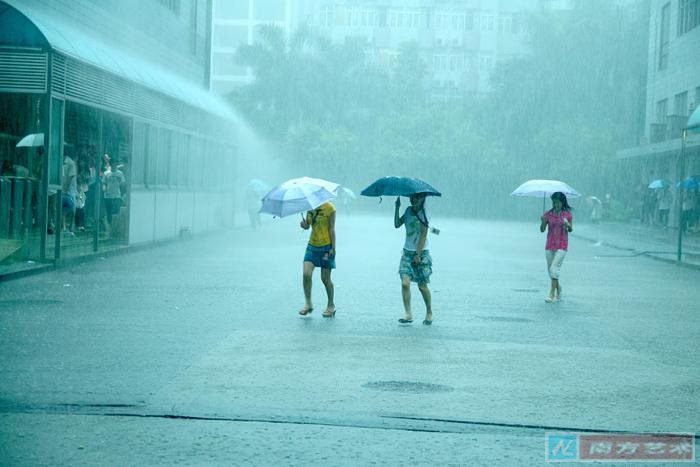
Zhan Youbing: Workers return to the factory, Dongguan, China (2008)
Ahong’s father was very industrious. He banded together with seven unmarried men on the production team. During the day, they worked together in the fields, and in the evening, they played cards, gambled and caroused in the production team dormitory. They were thrifty, spending what little they earned to survive.
In 1978, following the Third Plenary Session of the Eleventh Central Committee, the communal agricultural collectives were gradually disbanded, and the production team’s farming implements (ploughs, harrows, hoes, sickles, windmills) and livestock were returned to individual farmers. Once the plots were redistributed, the communal housing was also torn down, and the other bachelors were left with nowhere to live. Some sought refuge with an uncle or stepfather; others sold the plots and implements they’d been allotted and left to work as fishermen along the lake, or went to the city as migrant labourers. Ahong’s father had nowhere to go and no relatives to turn to, so he stayed in the village. He went to Huzhou to cut reeds to build himself a thatched hut.
After the division of land into privately owned plots, as the countryside suddenly underwent a revival, most of those bachelors sold their share of the farming implements to Ahong’s father for instalments of cash. A hard worker and adept at farm labour, he brought in good harvests. During the busy seasons, he lent his plow ox to help others. His life was much better than it had been during collectivism, but he was a man used to playing cards, smoking, eating and drinking to excess. He never made plans further than a day’s work, and so had no prospects for a family.
The next year, one of the bachelors returned. While working as a fisherman, he had married the daughter of a lakeside family. His wife had a younger sister who’d been sickly as a child, but who could work. She was tall, not particularly clever, but not too stupid either. She was also pregnant, and no one knew who the father was. Now that her belly was growing big, they were desperate to marry her off.
In the early 1980s in rural China, an unmarried man older than 25 was considered a hopeless bachelor. Ahong’s father was already 28. At his friend’s suggestion, he married the pregnant woman. Although Ahong knew he wasn’t her biological father, he loved her so deeply that she never cared.
Ahong’s father had always wanted a son, but her mother gave birth to three girls. Family planning rules were very strict. When her mother got pregnant again, she took Ahong to her aunt’s house to hide from the local officials. Even so, they were found out. They had left their own house vacant, but the officials still cleared every last thing out of it to pay the fine. They confiscated her mother’s dowry of a bed and a cabinet, their piglets, and even some unhusked, still-damp rice.
Poverty, utter poverty – that was the word Ahong used the most. Every year it was impossible to pay the school fees. Because they were always behind, she dreaded going to school, worried that the teacher would press her for money. They couldn’t even afford her textbooks. All Ahong could do was sit in the back row and listen uncomprehendingly. Her grades were poor, and she was often kept back. She left school at 15, still only in fifth grade.
*
In the 1990s, Ahong’s village saw its first wave of workers leave in search of jobs. The women did so before the men. Around 1995, some women went to Guangdong to work in the sex industry. The village still maintained its ancient ethical codes, and malicious gossip followed those who turned to prostitution, but such moral high ground quickly subsided under economic pressure.
The group of women working as prostitutes gave rise to a group of pimps. Most of them were young men who would go into the villages and lure girls into leaving for Guangdong. One pimp noticed Ahong, who had been at a loose end for six months. He invited her to a nearby town and drove her to a video arcade on his motorbike, a rare sight in the countryside. She felt special as they zipped down the roads. He bought her clothes and lipstick, and she grew closer to him. One day she followed him south. At 16, she started working as a prostitute at a salon in Shunde.
Ahong said she had let her father down. After she left, he looked everywhere for her. When he discovered what happened, he went to the pimp’s home to get her back - and was beaten up badly by several young pimps there. Her father had never left the village, and had never been on a train. He knew that Ahong had been swindled, but he had no idea how to find her. He borrowed from loan sharks and hired others to look for her, but he only got scammed. Ahong felt guilty about what had happened to him, but after working in the trade for seven years, she had learned to live with it.
She lit another cigarette. She said that at first she despised the pimp who had deceived her. She was so young then, and didn’t know anything. But she also said she couldn’t have stayed at home. Most of the other girls her age had left the village, following the pimps, willingly or not. Ahong sighed. “The pimps have changed our village. You go back and see that people are used to it. There are so many girls doing it. And besides, it brings in good money.”








 川公网安备 51041102000034号

