
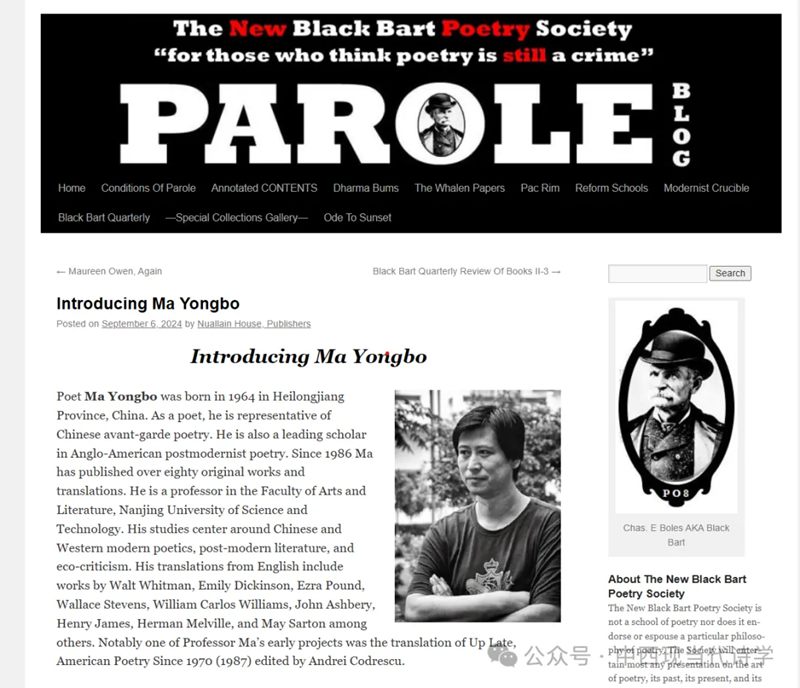
发表于美国,并附有10首马永波的英文诗。
https://thenewblackbartpoetrysociety.wordpress.com/2024/09/06/introducing-ma-yongbo/
Poet Ma Yongbo was born in 1964 in Heilongjiang Province, China. As a poet, he is representative of Chinese avant-garde poetry. He is also a leading scholar in Anglo-American postmodernist poetry. Since 1986 Ma has published over eighty original works and translations. He is a professor in the Faculty of Arts and Literature, Nanjing University of Science and Technology. His studies center around Chinese and Western modern poetics, post-modern literature, and eco-criticism. His translations from English include works by Walt Whitman, Emily Dickinson, Ezra Pound, Wallace Stevens, William Carlos Williams, John Ashbery, Henry James, Herman Melville, and May Sarton among others. Notably one of Professor Ma’s early projects was the translation of Up Late, American Poetry Since 1970 (1987) edited by Andrei Codrescu.
Interview conducted by Pat Nolan, August 2024.
It is a distinct pleasure to include a selection of Doctor Ma’s English poems as a pdf file following the text of the interview. Click on the link provided.
What first drew your interest to literature, poetry in particular? Were you introduced to it in school or through recommendations from friends?
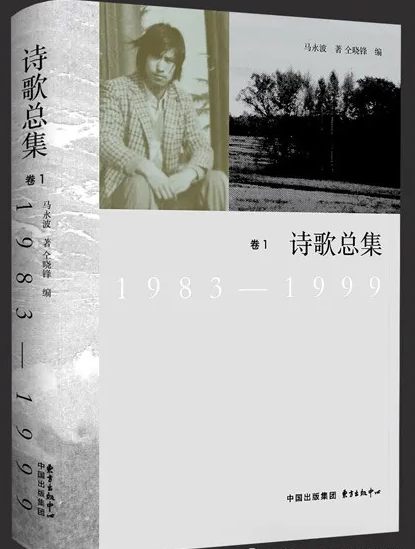
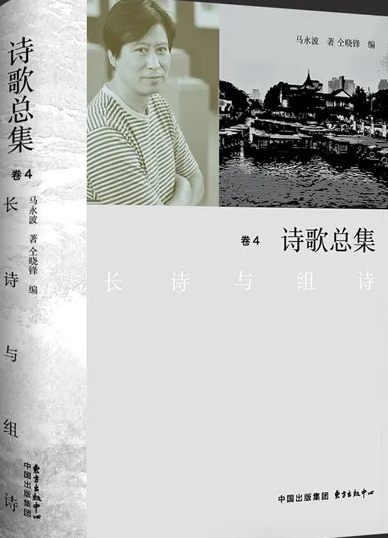
My interest in literature probably has several origins. In elementary school, one of the books from my father, who was a colonel, left the deepest impression on me—it was the Philosophical Dictionary compiled by the Soviet scholar Rosenthal Yudin. Then there was a box of classic foreign literary works that my eldest brother Yongping (also a poet) brought back when he left the army. There were also the literary magazines subscribed to by my elder sister, who was a middle school Chinese teacher. These were my earliest enlightenment. In the third year of middle school, my Chinese teacher transcribed my essay on the blackboard with chalk, constantly encouraging me. From then on, I became the best student in the school, and by high school, I was the best in my grade, especially in Chinese and English. In the first year of high school, I started writing novels, plays, and poems, receiving further encouragement from my Chinese teacher. When I took the college entrance exam, my essay received a perfect score—a rarity. In 1981, I was admitted to Xi’an Jiaotong University, ranking first among the 25 students the university recruited from Heilongjiang Province that year. However, after entering university, I wasn’t very interested in my computer software major, so I picked up my love for writing poetry again, essentially trying to find a pillar for my sense of self-worth. In my university English class, I translated several African American poems as an exercise and received encouragement from a beautiful female teacher (if she hadn’t been beautiful, things might have been different). This planted another seed of curiosity about the world. During university, I was fortunate to find a community—I joined the “Sparks” literary society on campus and met a group of campus poets, some of whom became lifelong friends. One such friend is the poet Tong Xiaofeng, who later concentrated on film screenwriting, directing, and production in the 1990s. He is the compiler of my four-volume Complete Collection of Poems.
These seem to be external reasons. The internal reason, as I now look back, should be the intense confusion about life and death that I felt around the age of six. These ultimate questions have been at the core of my thinking throughout my life. At the age of 11, I had an experience of “spiritual vision” that is difficult to explain in words. I suddenly found myself within the “totality of existence,” directly perceiving the entire universe. The linear separation of time no longer existed, and everything from the past, present, and future appeared simultaneously. Such a mystical experience rarely occurs in the Chinese language, and those few seconds were indescribable in words. It was similar to Gary Snyder’s realization of the interconnectedness of all things when he returned a book to the shelf in a Kyoto library, or Mary Austin’s childhood “encounter with God” under a chestnut tree… I believe that all my literary and intellectual pursuits to this day have been an attempt to return to that Edenic state of unity with all things that I experienced at 11. From the beginning, my goal has been not just the pursuit of literature itself, but something intimately connected with transcendent existence—though I didn’t even rationally realise this myself until I was in my thirties.
At what age did you seriously consider writing poetry? Who were your influences?
I started writing poetry in the first year of high school, in 1980, when I was 16 years old. At that time, I also began to submit my work to publications, but none were accepted until 1986, when I was about to graduate from university. That was when my so-called “debut work” was published—a long poem. I still remember that the payment I received for it was equivalent to two months of living expenses. Starting in 1981, when I entered university, I devoted myself entirely to writing poetry. The reason was that I encountered some setbacks in my studies. I had been the top student in middle school, but in university, my grades only ranked in the middle, which was a bit disheartening. So, I turned to writing poetry. After all, one has to find a path in life, and at that time, I had a vague sense that if I couldn’t become a poet, I wouldn’t be able to accomplish anything else. It seems that Borges had a similar feeling.
When I first entered university, I voraciously read Tang and Song poetry, transcribing and memorizing them, competing with fellow poetry enthusiasts to see who could remember the most Tang poems. I memorized the Lì Wēng Duì Yùn and other classical poetic forms, and I even wrote verses following the set structures of traditional Chinese poetry. Though these classical poems were full of clichés, I filled up two notebooks with them. Once, in a moment of impulse, I gave those notebooks to a girl. As it turns out, I can’t even remember her name now.
When were you exposed to Western poetry? Which authors, and were they only English language?
In middle school, I mainly liked Byron, Shelley, Goethe, Pushkin, Tagore, and Gibran, among others. In university, I encountered poets like Yesenin, Mayakovsky, Neruda, Reverdy, Apollinaire, Rimbaud, Keats, Wordsworth, Dickinson, Whitman, Eliot, Dylan Thomas, Ginsberg, and more in the library… It’s impossible to list them all. Here, I can highlight a few poets I particularly liked during my university years: Neruda’s The Heights of Machu Picchu, Mayakovsky’s A Cloud in Trousers, Keats’s Bright Star, and Ginsberg’s Howl.
Aside from poetry, Indian philosophy also had a significant impact on me during my university days, especially the Upanishads and The Life Divine. I consider them to be truly great poetry. These poets and works fundamentally changed my perception of the world and led me down the path of modernism, moving away from the traditions of romanticism and realism. Around 1983, I began to delve into the heart of modern poetry. This is a steep and narrow path, but as Dante said, it is the “right road,” and I consider myself fortunate to have found it.
What led you to specialize in US poetry?
Although I read a lot of American poetry during my university years—Longfellow, Dickinson, Whitman, and others—I don’t know why, despite recognizing their greatness, they didn’t truly resonate with me at the time. Reading Dickinson made me feel stifled, as if I were trapped in a narrow berth on a ship; reading Whitman, on the other hand, left me overly excited, unable to sleep, so I read him less. It wasn’t until after I graduated from university, as I grew older, that I gradually began to understand them. Eventually, I even translated and studied their works, publishing two books of Dickinson translations: a bilingual poetry selection and a collection of her poems and writings. As for Whitman, I published a small poetry collection for children, which was just over 40 pages, and the most comprehensive collection of his prose currently available in Chinese. Some experiences only occur after reaching a certain age. Similarly, a deeper and more accurate understanding of certain poets only comes with age and the corresponding life experiences.
In 1985, Fredric Jameson came to China to give lectures, and his lecture notes were published in Chinese in 1986 under the title Postmodernism and Cultural Theory. This coincided with my university graduation. His book was quite popular in the reading circles of the 1980s. At that time, Chinese cultural and intellectual thought was still largely rooted in the Enlightenment tradition inherited from the May Fourth Movement, immersed in the admiration of modernity. But Jameson suddenly introduced a group of postmodern theorists like Foucault, Hassan and Lacan, bringing postmodern theory to the forefront. This book had an impact on me, but due to the scarcity of translations of postmodern works, especially poetry, in Chinese at that time, I could only get glimpses through the fragments quoted in theoretical articles. In the early 1990s, due to limited resources, it was difficult for me to obtain original English poetry collections. I need to photocopy them from libraries or had them mailed from the United States. A poetry friend from my university days, Gu Yifan, who was studying in the U.S., sent me The Collected Poems of W. H. Auden, an English Bible, and The Contemporary American Poets: American Poetry Since 1940 edited by Mark Strand. By the early 1990s, there were quite a few translations of postmodern theory and novels in China, but still no entire collections of postmodern poetry.
Starting in 1990, I began extensively reading and translating British and American poetry, along with some novels, and I’ve almost never stopped. It’s been about 35 years now, and I’ve published or I am awaiting the publication of around a hundred translations. Among those published relating to American poetry are The Contemporary American poets: American Poetry Since 1940 (511 pages), The American Poetry Since 1950:Innovators and outsiders (744 pages), The American Poetry Since 1970:Up Late (717 pages), The Selected Poems and Letters of Emily Dickinson (395 pages), The Selected Poems and Essays of Ezra Pound (1218 pages), The Selected Poems and Prose of Wallace Stevens (407 pages), Paterson by William Carlos Williams (402 pages), Selected Poems of Amy Lowell (410 pages) and The Selected Poems of John Ashbery (a three-volume bilingual edition totaling 831 pages). Among these, I spent eight years translating Contemporary American Poets: American Poetry Since 1940 and The American Poetry Since 1970:Up Late, which were the first anthologies titled “Postmodern Poetry Selections” in Chinese. These anthologies are primary influences on postmodern Chinese poetry. Besides introducing these large anthologies in whole book-length, I have conducted specialized studies on several major American poets from modernism onward—Whitman, Dickinson, Stevens, Pound, Williams, Bishop, Ashbery, and others. Next year, I plan to translate Charles Olson.
Why am I so obsessed with American poetry? Initially, it was mainly out of curiosity. I wanted to understand what postmodern poetry was really like. It’s undeniable that America is the birthplace of postmodern poetry. As I delved deeper, I became drawn to the strong experimental spirit of contemporary American poetry, its broad absorption of experiences, and its tremendous vitality born from heterogeneous mixtures. Compared to the elegance and refinement of European poetry, I prefer the openness and inclusiveness of American poetry. It seems that anything can be written into a poem, as if Whitman’s democratic ideals have given birth to a truly diverse and unconstrained aesthetic community in American poetry—something I don’t see in Chinese poetry.
Were there any other modern movements that caught your interest? Surrealism, structuralism, Dada?
My interests are quite broad, encompassing the various currents of the overall modernist movement, such as Symbolism, Imagism, Futurism, French Surrealism, German Expressionism, and Latin American Magical Realism. Dadaist art, in particular, tends to captivate people’s interest. Despite many Chinese poets having been exposed to Dadaist and Surrealist poetry, it’s curious that these movements did not give rise to a Surrealist school within Chinese poetry. Surrealist elements in Chinese poetry are often diffused throughout individual works rather than forming a cohesive movement or group. This is similar to the fate of New Criticism in Chinese literature, which is largely confined to university classrooms and the writings of so-called academic critics, with most poets and readers not adopting this method of reading poetry. I speculate that Surrealism did not take root in Chinese literature due to the constraints of the Chinese literary tradition, whose two most powerful traditions are lyrical expression and moral sentiment, roughly corresponding to Romanticism and Realism, both deeply entrenched. While Chinese poetry has absorbed the Surrealist exploration of the unconscious, its “exquisite corpse” and automatic writing have never really taken root in Chinese.
I’m also interested in the various schools of American poetry after World War II—the Middle Generation, the Confessional poets, the Beats, the New York School, the Black Mountain poets, Neo-Surrealism, Language Poetry, Performance Poetry, and some unclassifiable poets. Among these, the Confessional poets, the New York School, and Neo-Surrealism have had the most significant impact on contemporary Chinese poetry. For instance, Plath’s influence on Chinese feminist poetry, Ashbery’s impact on intellectual writing, and Neo-Surrealism’s influence on Southern poets. The Beats’ rebellious stance attracted the attention of many Chinese poets, but due to cultural constraints, the spirit and attitude of the Beats—marked by a disregard for convention—are hard to find in Chinese poetry, just as the openness of the Black Mountain poets and the broad inclusiveness of Pound are lacking. Neo-Surrealist poets like Bly and Wright are popular in China because their works often relate to nature, elevating images and thoughts from the context, which resonates with the unity of heaven and man in classical Chinese poetry. Their poetry is refined and comfortable to read, so it’s more widely appreciated.
What interests me in American poetry is not its Chinese elements or perhaps the fictional “Chinese imagery” (which may be just a fantasy), but those aspects that are lacking in the Chinese language.
The spirit of the Beats and the Black Mountain poets, however, is not easily transplanted into Chinese poetry, as the cultural environment doesn’t nurture it. Even if some individual poets are drawn to these movements, they find it difficult to gain momentum and become mainstream. Chinese poetry tends to favor and embrace works that are gentle, elegant, and moderate, avoiding extremes. The core of Chinese culture is the doctrine of the mean—balance and impartiality—which leads to a rejection or disregard for anything radical, experimental, or exploratory. Personally, I believe that the lack of grand, vigorous, and dynamic poets in Chinese literature, akin to Whitman, Pound, Williams (the Williams of Paterson, not the Williams of The Red Wheelbarrow), Ginsberg, Olson, or Jerome Rothenberg, is why the avant-garde spirit in Chinese poetry has struggled to establish itself. Even in the new century, in the era of internet poetry, the exploratory spirit of the 1980s and 1990s has severely declined and become lethargic. What Chinese poetry lacks is not refinement and elegance, but the vitality of life and the pioneering spirit of bold experimentation.
Tell me something about contemporary trends in Chinese poetry
It is very difficult to summarize the overall trends in contemporary Chinese poetry, as each poet may have their own perceived trends and directions. However, I am still willing to take the risk of offering my personal summary: objectification. Since the era of Tang and Song poetry, there has been an overwhelming tradition in Chinese poetry—lyricism. The vernacular language revolution of the New Culture Movement severed Chinese New Poetry from the classical poetry that adhered to fixed patterns, which is similar to how English modern and contemporary poetry abandoned the constraints of meter. From the mid-1980s to the present, I believe the greatest advancement in Chinese poetry has been the strengthening of narrative elements, using experiential poetics to correct the overly dominant lyricism. However, poetry has not abandoned lyricism; rather, it expresses lyricism through narrative. The stance of the lyrical subject has shifted from the traditional solipsistic self-expression to a voice that identifies the subject as an ordinary member of the universe. To draw an analogy, the previous form of lyricism was akin to the relationship between an actor on stage and the audience below, whereas now, the actor and the audience are mixed together, the stage has disappeared, and the consciousness of the speaker in the poem is merely one of many subjectivities, similar to Bakhtin’s concept of the “polyphonic novel.” I am not sure if this description conveys my meaning. If I were to use a more precise term, it would be that contemporary Chinese poetry places more emphasis on intersubjectivity rather than the old human-centred subjectivity. This is clearly related to concerns of ecological holism and also to the phenomenological “return to the life-world.” Chinese poetry, long known for its subjectivity, is now turning towards objectification, shifting from expressing the self to presenting things.
The history of Chinese vernacular poetry is just over a hundred years old, beginning with Hu Shi’s The First Collection of Experiments in 1920, and its development has always been inseparable from the catalysis and nourishment of European and American influences. Various “isms” have been adopted to serve the real situation of Chinese culture. I cannot elaborate on the specific influences of various schools of thought here, so I will only briefly mention a few: the influence of Romanticism on Guo Moruo, the influence of Existentialism on Feng Zhi, the influence of Anglo-American Modernism on Mu Dan and others, the influence of Russian Silver Age poetry on the Misty Poets, the influence of various contemporary American poetic schools on the Chinese Third Generation poets to which I belong, and even the clear traces of specific influences in the works of many important poets.
So, here a sharp question arises: where is the originality of contemporary Chinese poetry? This question has always troubled me. Classical Chinese poetry inspired the Imagism of Ezra Pound and Amy Lowell, and Chinese Zen Buddhism influenced some American poets. But when I read the works of these American poets, I feel a sense of familiarity and can appreciate them, but when I translated Pound and Amy, I didn’t translate Cathay or Fir-Flower Tablets. What interests me in American poetry is not its Chinese elements or perhaps the fictional “Chinese imagery” (which may be just a fantasy), but those aspects that are lacking in the Chinese language. Conversely, I have never been able to fully understand what aspects of contemporary Chinese poetry interests American poets. Perhaps what is effective in Chinese becomes ineffective in English? I don’t know. Perhaps true poetry can withstand the test of translation—what is excellent in Chinese can still be seen as excellent when translated into English—but this, too, I cannot be sure of.
As a scholar, you have specialized primarily in US literature (North American English), what are the most difficult aspects of translating an idiom rich language that relies so much on the vernacular?
Cultural differences do pose a significant challenge in translation, especially when I was translating contemporary English and American poetry in the 1990s without access to the internet. Reference materials were scarce, and I was always living and working in non-English environments, which made the task incredibly difficult. The translations of American Poetry Since 1940 and American Poetry Since 1970 were truly laborious endeavors, navigating through uncharted territory and overcoming numerous obstacles. After the advent of the internet in 1999, things improved considerably; much of what I didn’t understand could be looked up online. So, most of the cultural barriers can be overcome. Another challenge is translating puns, which often lack equivalent expressions with the same meanings in Chinese.
I was the first to translate John Ashbery into Chinese, and to date, I started translating his work in 1990, and it wasn’t until 2003 that they were published. His poetry is inherently obscure, and there were no annotations available. At that time, the lack of resources was a major issue; since I was the one introducing his work into Chinese, there was no one else I could discuss it with. Nowadays, the problem of reference materials is largely resolved—there’s an abundance of e-books available.
Another interesting aspect is the use of verb tenses in English, which doesn’t exist in Chinese. So, concepts that require complex expressions with various tenses in English become very simple and concise in Chinese. The word count ratio between English and Chinese texts is about 3:1, meaning that 3,000 words in English translate to about 1,000 words in Chinese. As a result, what would be a several-hundred-page tome in English becomes just a slim little book of around a hundred pages in Chinese.
Also, because of the range of US poets you have translated, what trends or themes do you find in US poetry that surprise you or disturb you?
I have indeed read a substantial amount of American poetry. In fact, the reason I have worked so diligently to translate these works is that I wanted to gain a deep understanding of them. Translation is close reading—no one reads a poem more carefully than the translator. If I don’t record in Chinese what the original English poem is saying, I would forget it after reading it. So, I refer to my translations as “recording” the poems in Chinese. However, to be honest, there are many poets I haven’t had the time to study in depth—my energy is limited. The poets I’ve made an effort to research thoroughly are generally those I’ve translated. I’m accustomed to translating by hand, and through this process, I experience a certain imagined joy of intellectual exchange by reading the voices of minds from a distant land, though of course, it’s a one-way communication. To compensate for the limitations of my personal energy and interests, I came up with a more efficient method to understand American poetry: conducting a series of interviews with American poets. Through their responses, I can quickly grasp their ideas, poetic journeys, and the key achievements and focal points of their poetics. I am also planning to conduct an interview with you and am currently preparing the outline.
What surprises me about American poetry? One thing, for example, is the mixed evaluation of Ashbery. There are quite a few accomplished American poets who have reservations about his “deliberate ambiguity.” In fact, I’ve grown a bit weary of him myself. Reading too much of his poetry can become tiresome—it’s enjoyable to read a few poems occasionally, but too many at once can be overwhelming. Another aspect that unsettles me is the excessive colloquialism in some American poetry, such as that of O’Hara and Bukowski. I can appreciate their work, but I can’t truly love it, even though I’ve translated several of their poems. Colloquialism, while it has its appeal and can incorporate a wide range of everyday, mundane subjects into poetry—even to the point where “nothing is unfit for poetry”—can easily result in a lack of depth and a superficiality, much like Andy Warhol’s diamond dust shoes. In contrast, Van Gogh’s “A Pair of Shoes” is more captivating to me—it carries behind it a vast, meaningful world, just as Heidegger once analyzed.
Since last year, I have gradually developed an interest in new narrative and new formalist poetry in American literature, which had previously received little attention from Chinese poets and scholars. For instance, I translated a selection of poems by Rosanna Warren, who doesn’t seem to belong to any postmodern school. Her poetry has a strong narrative element, which bears some resemblance to my own practices in Chinese poetry.
Another phenomenon that perplexes me is the sheer number of poetry awards in the United States. Apart from a few, it’s hard to distinguish which ones are truly authoritative. What’s more, I’ve noticed that some poet laureates and award winners produce work that isn’t as strong as that of poets who haven’t received any major titles or awards. Am I misunderstanding poetry, or is the evaluation system for American poetry, like that in China, plagued by serious issues? I honestly don’t know. In China, for a true poet, receiving an official poetry award is not an honor but a disgrace.
What aspects of US poetry, formally or stylistically, affect your own poetry in Chinese?
I respect all forms of artistic experimentation, but I am not very interested in extreme formal experiments like visual poetry or concrete poetry. To be honest, there is no space in Chinese for such extreme experiments. Official publications always feature uninspired and inconsequential poetry, while underground publications have a very limited reach, circulating only among a few friends. As for stylistic influences, it’s hard for me to pinpoint because Chinese and English are fundamentally different languages. I have invested effort in translating the works of Ashbery and Bishop, with Bishop’s collection translated at the beginning of the century, but it still hasn’t been published. Their work has had a potential impact on my poetic ideas. For example, Ashbery’s meta-poetry and Bishop’s painterly attention to detail have both been inspiring. My primary interest lies in the poetic philosophies of American poets. I have never imitated anyone’s specific language style, nor could I, as we are working with two different languages. What I study are their ideas and techniques, which help me address my own Chinese experiences. Despite my fondness for foreign poetry, I am fundamentally Chinese. I believe that my poetic form and philosophy grow from my concrete life experiences. This is not to deny the importance of foreign influences, but rather to say that if foreign influences remain at a technical level without being organically integrated with one’s own awareness and experiences, the outcome might not be positive and could even be detrimental.
Tell me how you learned of UP LATE and what led you to translate that particular anthology of late 20th century US poetry.
In the early 1990s, I made a copy of this poetry collection, edited by Andrei, from the Xi’an woman poet Zhao Qiong and cherished it dearly! At that time, Chinese literature primarily introduced postmodern theories and novels, with figures like Jameson, Roland Barthes, Lyotard, Nabokov, and Borges. Before I began translating American postmodern poetry, there were certainly other collections of American poetry available, but none were explicitly focused on “postmodernism.” My translation of American Poetry Since 1970 was driven mainly by curiosity. At the time, I was just a computer software engineer at a century-old railway vehicle factory, with no university background in English or Chinese education. By chance, I began a journey that I couldn’t stop, and as a result, I have been translating for over thirty years! This book was published in the late 1990s, a turning point in the transformation of Chinese poetry. Objectively speaking, it provided fresh material that was rare at that time, and various postmodern experiments in Chinese poetry are more or less related to it. Unfortunately, due to limited conditions, I was unable to obtain the poetry collections of the poets included in this book, so I couldn’t continue my in-depth research.
In the spring of 2023, I had a sudden idea and tried to contact these outstanding poets I translated when I was a young poet under 30. As a result, I spent that year immersed in a kind of blissful state. I was able to get their poetry collections and even chat with them occasionally!
—Ma Yongbo, August 23, 2004, Harbin





 川公网安备 51041102000034号

