
Nasir Aijaz Interview by Ma Yongbo
How did you begin writing poetry? Was there a specific moment or event that set you on this path?
The answer may be a little bit long.
I am a journalist and researcher who has authored ten books on subjects such as literature, language, culture, history, and travel. I am a poetry lover who never imagined writing poetry myself.
To be very frank, I became a poet accidentally and started weaving words into poems about a couple of years ago. Before that, I translated poetry of some contemporary poets, from English to Sindhi and from Sindhi to English, though very occasionally. I sometimes wrote free verse in Sindhi, my mother tongue, but I never published it in magazines or newspapers. About seven or eight years ago, I translated some of Ashraf Abul Yazid’s poetry—an Egyptian friend—and other poets as well, and published the translations in a local magazine. Later, I decided to translate Ashraf’s entire poetry book. That Sindhi translation was published in Egypt in book form. Although I began my literary journey as a translator in 1973, when I translated about a dozen short stories and two novels from foreign literature, I never attempted to translate poetry.
The last months of 2023 brought a turning point in my life when I was confined to bed after surgery and strictly prohibited from walking. Because I had built a following on Sindh Courier, some contemporary poet friends—who believed I was also a poet—suggested I share my poetry. During my bedridden days, I translated some of my free verses from Sindhi into English and shared them with fellow poets, who had them published. To my surprise, my poetry was well received. A short poem I wrote after surgery was highly praised and rewarded. The poem reflected my emotions of being unable to enjoy the rain outside while a pigeon, sitting on the window sill, was free to enjoy the downpour. I felt caged while the pigeon seemed free.
That experience prompted me to start writing poetry directly in English. This is how I became a poet. The details of my poetic life are given in my bio data.
Here is that poem:
A Cage
Lying in bed at midnight
The bedroom looks like a cage
Where I do live for months
Disconnected from the world
Imprisoned in the state of disability.
It was the first rain of winter outside
Alas, I couldn’t go outside to enjoy myself.
I just peep through the window glass
Hear the sound of raindrops
Listen to prolonged cooing sound of pigeon
Sitting on the window sill
Running in drops.
It makes me feel
The bird is free to enjoy the rain
I am confined to a cage.
How have Pakistan's culture, history, and your family background shaped your poetry?
Pakistan’s mosaic—its languages, landscapes, histories, and rituals—forms the soil in which my poetry grows. My family background brought me into intimate conversations about language, literature, culture and traditions, while the country’s history and political upheavals provide the pressure and resonance that push language toward urgency and nuance. I’m drawn to the tension between continuity and rupture, between memory and becoming, which frequently surfaces in my poems as imagery, cadence, and recurring motifs.
I belong to a well-educated family. My ancestors were educationists who, in earlier times, ran their own traditional schools. Later, a generation of my grandparents joined the government’s Department of Education, where they held key positions. They also maintained a large library. My grandfather, an officer in the education department, was not only an administrator but also a writer and the author of several books. My father, first an English teacher and later a lawyer, was also a writer. He authored several plays, which were staged annually to raise financial support for the high school in our hometown.
Hailing from the central part of Sindh, historically known as the Sahiti (literary) region, I grew up in a rich literary and traditional atmosphere. This region is also recognized as the home of the standard Sindhi language used in literature.
Pakistan was created in 1947 through the partition of the Indian subcontinent by the British rulers. The new country consisted of two wings: East Pakistan (present-day Bangladesh) and West Pakistan (today’s Pakistan, comprising four provinces). During the partition, tens of thousands of people were killed, while millions were uprooted and forced to migrate. Muslims migrated to Pakistan, while Hindus and Sikhs moved to India. The history of this country is filled with stories of bloodshed and suffering.
After partition, the rulers of the newly born nation soon turned oppressive. Their unjust policies fueled unrest in both wings of the country, ultimately leading to its disintegration within just 23 years, in 1971. The remaining part of Pakistan also faced similar issues. Unfair economic policies, growing disparities, and “divide and rule” tactics gave rise to poverty, unemployment, and a host of other problems. I have witnessed many of these developments and personally experienced the pain of injustice.
Which writers or traditions have most influenced your work?
I’ve drawn inspiration from a constellation of Sufi (Mystic) voices across Sindhi, Siraiki, Urdu, and Punjabi literatures, including poets who blend lyric intensity with social consciousness. The Sufi poets include great poets such as Shah Abdul Latif Bhittai, Sachal Sarmast, Sami of Sindh, and Baba Bulhe Shah of Punjab etc.
I’m especially attentive to rebel poets of modern days who refuse easy binaries—love and loss, spirituality and doubt, tradition and innovation—because they model the complexity I seek in my own work.
They are Sindhi poets such as Juman Darbadar, Haleem Baghi, Ibrahim Munshi and others while Habib Jalib and Faiz Ahmed Faiz of Urdu. They are known as rebel poets who voiced against the social injustices as well as against the tyrant rulers. There are many other names. Shaikh Ayaz, considered as the great poet of 20th century. He has influenced all the generations of last century and even today is he is celebrated.
Those Mystic/Sufi poets were also rebel poets of their time.
How do you understand the role of poetry in contemporary Pakistani society?
Poetry, in contemporary Pakistan, remains a site of reflection, critique, and empathy. It can comfort, provoke, preserve memory, and illuminate unspoken truths. In a society grappling with rapid change, poetry can offer a space for dialog across generations and communities, question dominant narratives, and translate the political into the personal so that readers feel both informed and ethically engaged.
In your poems, do you tend to express personal inner experiences or respond to social and political realities?
My poetry traverses both realms. The inner life - memory, longing, doubt, provides a private core that grounds questions about society. At the same time, social and political realities press upon the personal, shaping images, metaphors, and tonal choices. I strive for poems that resonate emotionally while remaining socially attentive, so readers feel the intimacy of the self-alongside the weight of collective life.
Do you have any forms or rituals when creating poetry, such as language choice, rhyme schemes, or writing environment?
My process is a blend of discipline and spontaneity. I pay close attention to language choices, where a word’s sound echoes a meaning, where a line break creates breath and pause. I work with a mix of forms, allowing liber lines to coexist with more deliberate cadences when they serve the poem’s mood. The writing environment matters too: quiet spaces for revision, but also moments of immersion - sound, memory, or conversation—that spark fresh associations.
What core themes frequently appear in your poetry? (e.g., love, religion, social justice, exile, time and memory)
Some recurring themes are:
Time and memory: how the past persists in the present, and how memory shapes perception.
Exile and belonging: the feeling of being between places, languages, and communities.
Love and faith: intimate longing alongside questions of spirituality and doubt.
Social justice: the moral imagination at work in confronting inequality and human vulnerability.
Language and identity: how language shapes selfhood in a multilingual and multicultural landscape.
How do you understand the relationship between "modernity" and "tradition"?
Modernity and tradition are not opposites but interlocutors. Tradition provides lineage, anchoring, and ethical memory; modernity offers experimentation, speed, and new perspectives. The strongest poetry often reconciles the two by reimagining traditional forms through contemporary concerns or infusing modern sensibilities into timeless motifs. The result is a living continuum rather than a clash.
What are your views on the current state of contemporary Pakistani poetry?
Contemporary Pakistani poetry is vibrant, diverse, and increasingly dialogic. There’s a richness of multilingual voices, cross-cultural exchanges, and a willingness to experiment with form and subject matter. Challenges remain—market pressures, access to publishing, and regional disparities—but the field is dynamic, with younger poets expanding the scope of what poetry can do and be.
How do you view exchanges with Chinese poets and scholars? Could you share your insights on the translation and reception of Chinese poetry in Pakistan?
Exchanges with Chinese poets and scholars can deepen cross-cultural understanding and broaden the horizons of readers. You know very well that translation acts as a bridge. In Pakistan, Chinese poetry has a resonant appeal—imagery rooted in nature, social philosophy, and concise lyricism, yet reception often depends on availability. Your question makes me recall Chinese poetry translated into Sindhi language by a Maoist politician Rasool Bux Palijo (Late). The book of translated Chinese poetry was published in 1960s. Academy of Letters, a state-run literary institution, based in Islamabad, has also published books of Urdu translation of Chinese poetry. In my view, the collaboration with translators and literary institutions of two countries can cultivate a more robust readership and richer dialogues between the two literary ecosystems.
In today's political and social environment, how can poets maintain an independent voice?
By cultivating a clear ethical compass and a disciplined craft, poets can avoid both capitulation to power and mere opposition for its own sake. Independent voice comes from: Naming truth without fear, while preserving empathy for all readers; Maintaining linguistic precision and imaginative risk in imagery; Engaging with diverse audiences, including marginalized communities, so poetry remains relevant and responsible, and building supportive networks with editors, translators, and fellow poets to sustain rigorous, non-dogmatic work.
What are your future writing plans or ongoing projects?
I’m continuing to explore ideas to thread regional languages with Urdu and foreign languages. It’s my humble desire to form an alliance of Pakistani writers of different native languages with world writers and poets, particularly those of neighboring nations like China, India, Iran, and Afghanistan etc. I’m also interested in engaging with younger readers through workshops and community projects that invite people to discover poetry as a living practice.
If you could summarize your understanding of poetry in one sentence, what would it be?
Poetry is the art of turning fleeting perception into lasting meaning, a practice of listening that illuminates both heart and world.
What do you hope younger generations of readers will take away from your poetry?
I hope they leave with a sense that language can bear witness without numbness, that their own experiences are worthy of careful listening, and that poetry can be a bridge - a space where despite differences, we pause, reflect, and imagine better futures together.
__________________
Introduction
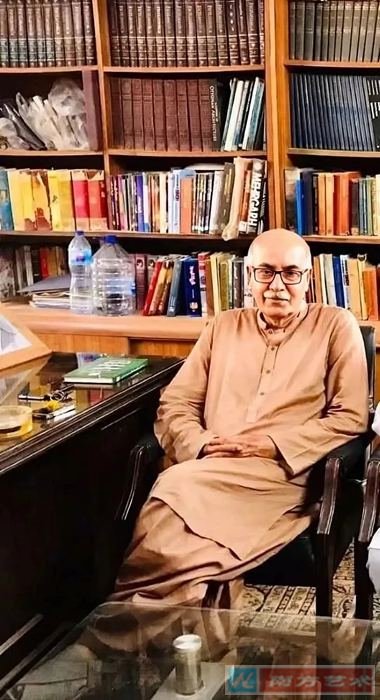
Nasir Aijaz, based in Karachi, the capital of Sindh province of Pakistan, is a senior award-winning and Gold Medalist journalist having served in the field of journalism for half a century in senior positions like editor and managing editor. He also worked as a TV Anchor for over a decade and conducted some 400 programs besides appearing as analyst in several current affairs programs on TV and Radio channels. He is award-winner author of ten books on history, language, literature, travelogue, translations from English literature, and biography. One of his books, translation of poetry of an Egyptian poet, has been published in Cairo. Besides, he has written over 500 articles in English and Sindhi, the native language of Sindh. He is editor of Sindh Courier, an online magazine and Chief Editor of Sindhi Edition of The AsiaN, an online news service of South Korea. Dozens of his articles have been published in South Korea while many of his articles have also been translated in Arabic and Korean languages. Some of his English articles have been published in Singapore, Egypt, India and Nigeria. His poems have been translated and published in over a dozen languages including Chinese, Hindi, Bengali, Tamil, and Malayalam, Albanian, Italian, Greek and Arabic language published in UK, USA, Algeria, Egypt, Abu Dhabi, Iraq, Bangladesh, India, Kosovo, Albania, Tajikistan, Greece, Italy, Germany, China, Italy and some other countries. Earlier this year, he was declared one of the Top 20 Journalists of Asia by Crown Legacy, a Manila-based magazine. He has received several certificates by world organizations in recognition of his services to world literature.







 川公网安备 51041102000034号

